I may earn a commission at no extra cost to you. #ad
Industrial-Grade Radiation Shielding Strategies for Residential Fallout Shelters
Jump to Section
In the realm of nuclear preparedness, the distinction between "makeshift" and "industrial-grade" can be the difference between basic survival and long-term health preservation. While consumer-level solutions offer a first line of defense, applying industrial shielding strategies—those used in medical imaging labs and nuclear power facilities—can significantly elevate the Protection Factor (PF) of a residential fallout shelter.
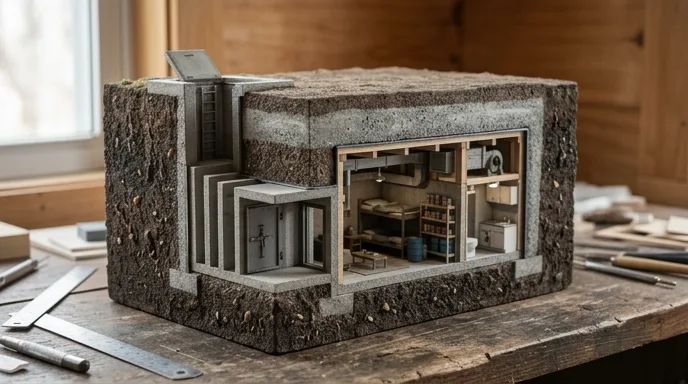
The Physics of Industrial Radiation Shielding
To understand industrial strategies, we must look at the Inverse Square Law and Half-Value Layers (HVL). Radiation intensity decreases inversely with the square of the distance from the source. However, in a fallout scenario, the "source" is a blanket of particles covering the ground above and around you.
Industrial shielding focuses on mass attenuation. Every material has a specific HVL—the thickness required to reduce gamma radiation by 50%. For example, approximately 0.4 inches of lead, 2.4 inches of concrete, or 3.5 inches of packed earth constitutes one HVL. To achieve a Protection Factor of 1000 (reducing radiation to 0.1%), you require roughly 10 HVLs. Industrial strategies aim to maximize mass in the smallest possible footprint.
Industrial High-Density Materials for Home Use
While standard concrete is a staple, industrial-grade protection often utilizes higher-density alternatives to save space and increase efficiency.
- High-Density Concrete: By using aggregates like barite, magnetite, or hematite, the density of concrete can be increased from 150 lbs/ft³ to over 300 lbs/ft³. This effectively halves the required thickness for the same shielding power.
- Lead Sheet and Brick: Lead is the industrial gold standard for gamma protection. Using interlocking lead bricks prevents "streaming"—radiation leaking through the seams of the shield.
- Tungsten-Polymer Blends: Often used in medical settings, these flexible materials offer high density without the toxicity or weight-handling issues of solid lead, though at a higher cost.
- Steel Plating: Used in conjunction with concrete, steel provides structural integrity and high-density shielding, particularly useful for ceiling reinforcements where weight is a critical factor.
Structural Geometry: Baffles and Mazes
Radiation acts much like light; it travels in straight lines. However, it can "scatter" or reflect off surfaces. Industrial facilities never use a straight-line entrance. Instead, they employ baffled entries or radiation mazes.
A residential shelter should incorporate at least one 90-degree turn between the exterior entrance and the living area. The walls of this turn should be just as thick as the main shielding. This ensures that any gamma rays entering the doorway must reflect off multiple high-density surfaces before reaching the occupants, losing energy with every "bounce."
Filtration and Ventilation Protection
Industrial shielding isn't just about the walls; it’s about the air. Radioactive fallout particles (alpha and beta emitters) are most dangerous when inhaled or ingested. An industrial-grade strategy employs a Positive Pressure System.
This involves using a HEPA and activated charcoal filtration system that pulls air in, filters it, and maintains a higher air pressure inside the shelter than outside. This prevents unfiltered air from leaking in through cracks or door seals. The intake pipes should also include a "sand filter" or a sharp U-bend to prevent direct radiation "shine" from particles settling in the vent pipe.
Retrofitting Residential Basements
Most residential basements provide a PF of 10-20. To reach industrial levels (PF 100+), focus on the "Inner Core" strategy. Instead of shielding the entire basement, construct a smaller, heavily shielded "foxhole" or inner room.
Focus on the ceiling first. In a basement, the floor above is the most vulnerable point because fallout accumulates on the yard and the roof. Adding a layer of steel plating or lead sheeting to the joists, supported by additional lally columns, can drastically increase safety without requiring a complete rebuild.
Measuring Shielding Effectiveness
Industrial safety relies on verification. No shield is guaranteed until it is tested. For a residential shelter, this means having calibrated instruments:
- Geiger-Müller Counters: For detecting high-energy gamma and beta particles.
- Personal Dosimeters: These are critical. They track the cumulative dose received over time, which is the most important metric for radiation sickness prevention.
- Rate Meters: To identify "hot spots" or leaks in your shielding where additional material may be needed.