I may earn a commission at no extra cost to you. #ad
The 2024 Free Guide to Radiation Shielding Blanket Technology and Lab Testing Results
Jump to Section
Understanding EMF Shielding Mechanics
Radiation shielding blankets operate on the fundamental principles of electromagnetism, specifically the Faraday Cage effect. When electromagnetic radiation, such as Radio Frequency (RF) from cell towers or Wi-Fi routers, hits a conductive surface, the electrons within that conductor redistribute themselves to cancel the radiation's field within the interior.
In 2024, the density of ambient radiation has increased significantly due to the proliferation of smart home devices and expanded 5G infrastructure. Modern shielding technology utilizes a microscopic lattice of conductive fibers woven directly into soft fabrics. This allows the blanket to remain comfortable for daily use while functioning as a high-performance barrier against non-ionizing radiation.
It is important to understand that these blankets are designed to block "far-field" radiation—the type emitted by external sources—rather than low-frequency magnetic fields produced by power lines, which require much heavier, specialized magnetic shielding (like Mu-metal).
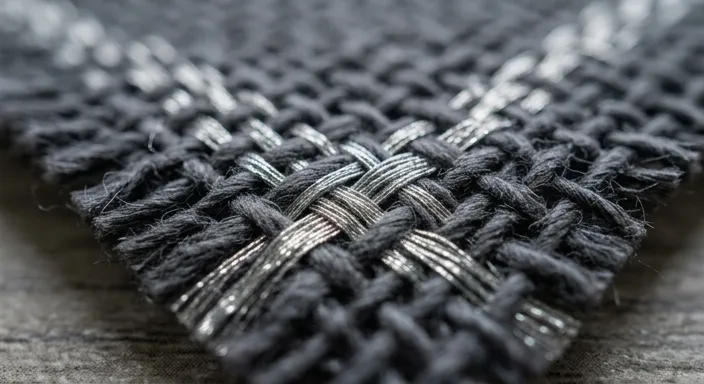
Conductive Materials: Silver vs. Stainless Steel
Not all shielding blankets are created equal. The choice of conductive metal determines both the effectiveness and the durability of the product. In current 2024 manufacturing, two primary materials dominate the market:
- Silver Fiber: Silver is the most conductive element on earth. When silver is bonded to nylon or cotton threads, it provides exceptional shielding (often exceeding 50dB). Additionally, silver is naturally antimicrobial and odor-resistant, making it ideal for bedding. However, it is susceptible to oxidation if washed with harsh detergents.
- Stainless Steel Fiber: Often used in industrial applications, stainless steel is highly durable and resistant to corrosion. While it is generally less conductive than silver, it is more cost-effective. However, it can sometimes feel "scratchy" or less flexible compared to silver-blended fabrics.
Top-tier blankets in 2024 often use a "sandwich" construction, where the conductive layer is hidden between two layers of organic cotton or bamboo fabric, ensuring that the metal never touches the skin directly.
Decoding Lab Testing Results and Attenuation
When reviewing lab results for a radiation blanket, you will encounter the term Attenuation, measured in Decibels (dB). This is the most critical metric for determining how much radiation is actually being blocked.
The math of decibels is logarithmic, meaning a small increase in dB represents a massive increase in shielding effectiveness:
- 10 dB: 90% of radiation blocked.
- 20 dB: 99% of radiation blocked.
- 30 dB: 99.9% of radiation blocked (Standard quality).
- 50 dB: 99.999% of radiation blocked (Premium quality).
Laboratory testing should ideally be performed by independent third parties using standard IEEE-299 or ASTM D4935-10 testing methods. These tests verify that the fabric maintains its attenuation across a wide spectrum of frequencies.
Frequency Ranges: 5G and Microwave Shielding
With the rollout of 5G, shielding technology has had to evolve. 5G operates across several bands: Low-band (under 1GHz), Mid-band (1GHz to 6GHz), and High-band (Millimeter Wave, 24GHz and above). Older shielding fabrics were often only tested up to 3GHz or 6GHz.
The 2024 standard for high-end blankets requires testing up to at least 10GHz, with many premium brands now providing data up to 40GHz. Because millimeter waves have shorter wavelengths, the conductive "mesh" of the blanket must be tighter and more consistent to prevent these waves from passing through gaps in the weave.
The Longevity of Shielding Fabrics
A common misconception is that a radiation blanket lasts forever. In reality, the shielding layer is a technical component that can degrade. Mechanical stress—such as folding, washing, and friction—can eventually cause micro-fractures in the silver or steel fibers.
To maximize the lifespan of your technology, 2024 lab studies suggest:
- Limited Washing: Wash only when necessary using distilled water or specialized EMF-safe detergents that do not contain bleaching agents or enzymes.
- Air Drying: High heat from dryers can melt or warp the fine metallic threads.
- Avoiding Oxidation: Keep the blanket in a dry environment to prevent the silver from tarnishing, which can slightly reduce conductivity over many years.
FAQ: Radiation Blanket Technology
Can I test the blanket with my cell phone?
While putting a phone inside the blanket may show a drop in signal bars, this is not a scientific test. Phones often boost their power output when they detect a weak signal. Use a dedicated RF meter for accurate home testing.
Is the silver in the blanket safe for skin?
Yes. Most blankets use ionic silver or silver-plated nylon that is inert and safe for human contact. High-quality blankets encase the silver layer between layers of soft cotton for added comfort.
Does it matter which side faces the body?
Generally, no. Since the conductive mesh works by reflection and absorption, it acts as a barrier regardless of orientation, provided the entire area you wish to protect is covered.